

Receiving a police summons, or being arrested without warning, is a moment when most people panic and have no idea what rights they have. Thailand's Criminal Procedure Code nevertheless sets out clear protections for arrested persons and suspects. This guide covers the key rights, how long the police may hold you, and how bail works, with foreigners in mind.
Summons or arrest warrant: what is the difference?
A summons is a letter from the inquiry official (the police investigator) asking you to come in on a set date to hear the charge or give a statement. It is not an arrest. If the date does not suit you, call the investigator named on the summons in advance to reschedule, and bring a lawyer on the day.
Do not ignore it. Under Section 66, a person who fails to appear under a summons or appointment without a reasonable excuse is presumed likely to flee, which is a ground for the court to issue an arrest warrant, a court order allowing officers to take you into custody.
What officers must tell you when they arrest you
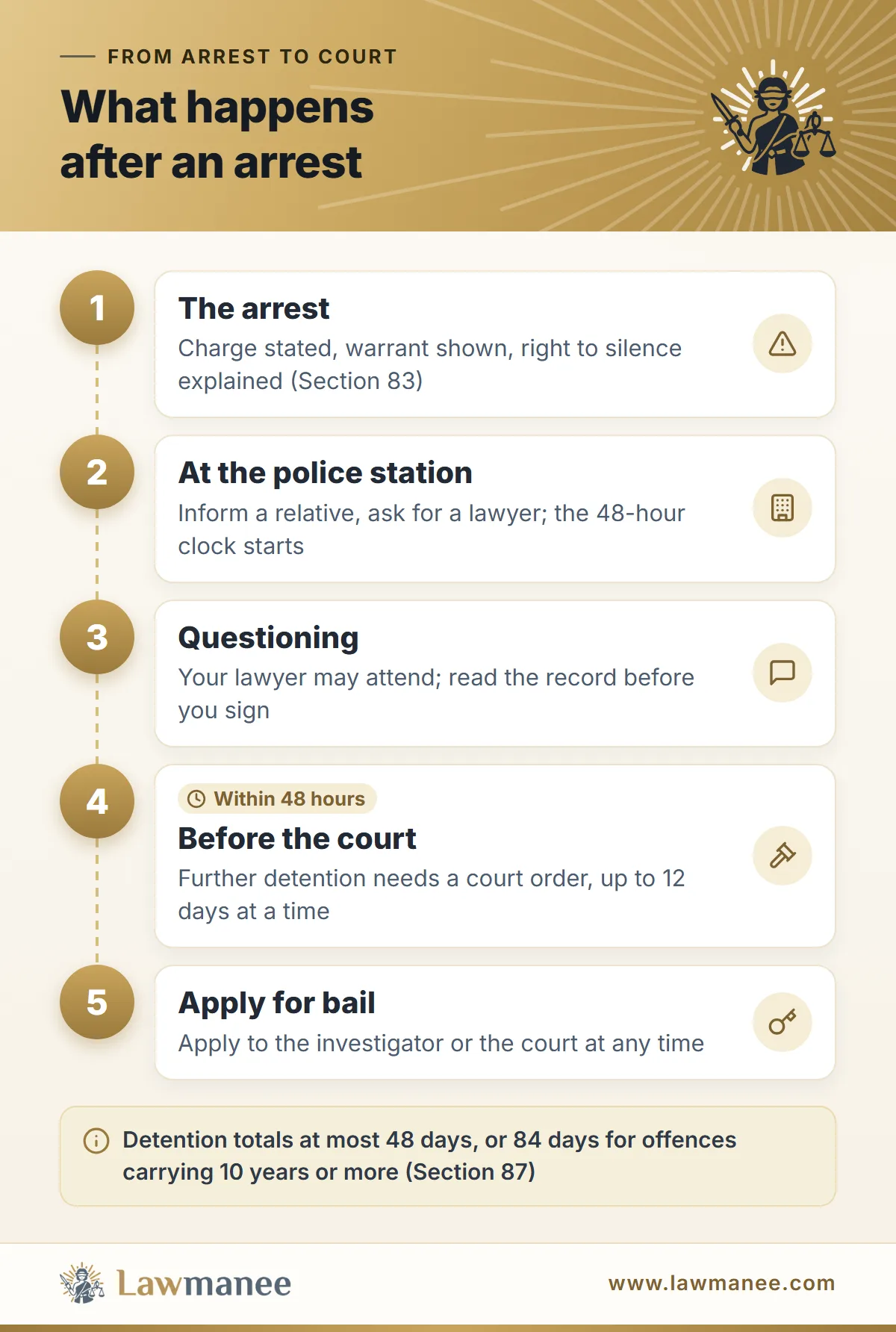
Under Section 83, the person making the arrest must tell you that you are under arrest and what the charge is, show the warrant if there is one, and tell you that you may choose to give a statement or not, and that anything you say may be used as evidence at trial. You must then be taken to the inquiry official's office at once (Section 84).
In that moment: stay calm, do not resist or argue, ask to see the warrant and note the officers' names or unit.
Five rights of an arrested person or suspect
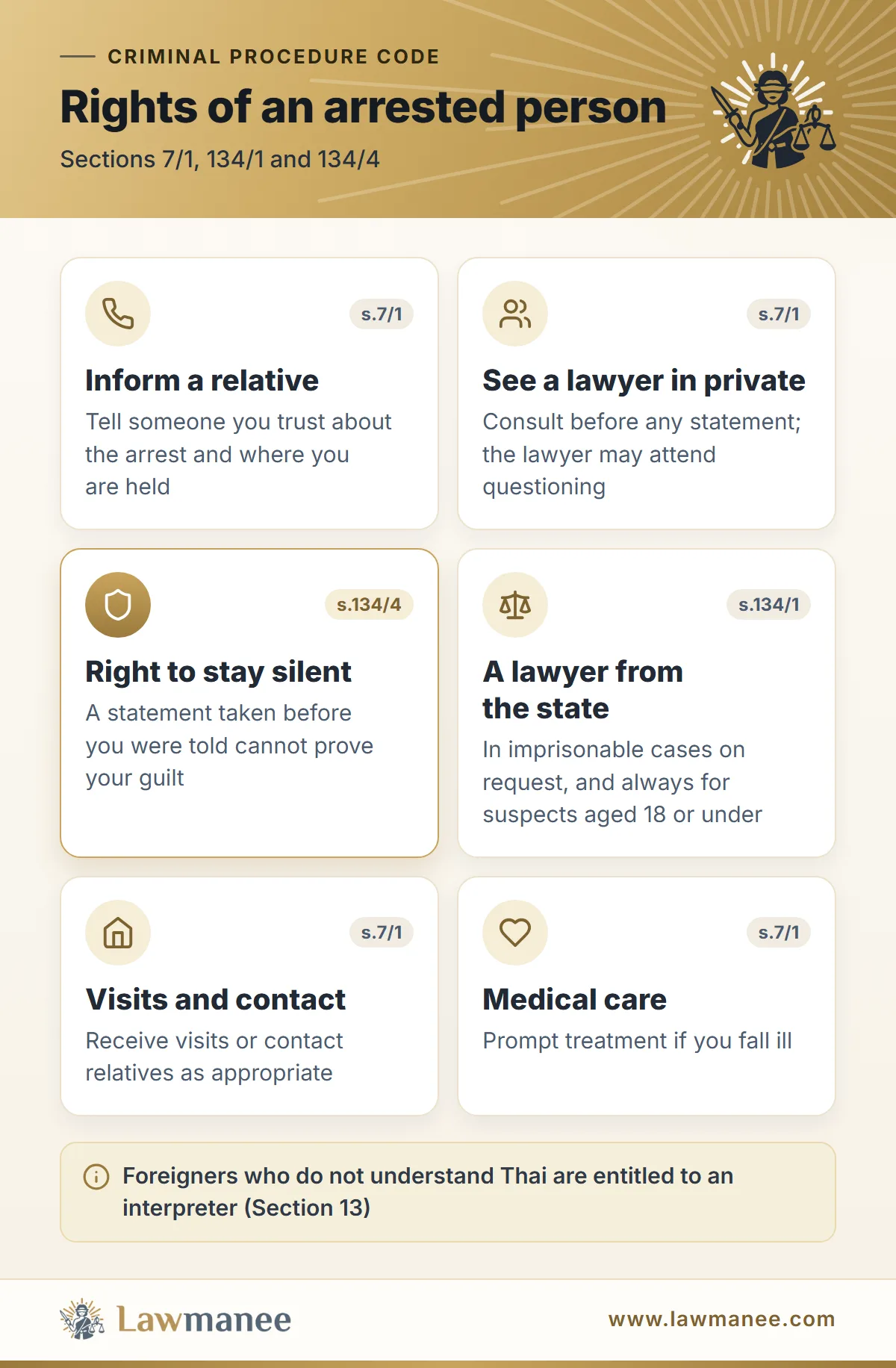
Section 7/1 gives anyone arrested, held or detained the right to:
- Tell a relative or a trusted person at the first opportunity that they have been arrested and where they are held
- Meet and consult a lawyer in private
- Have a lawyer or a trusted person present while the police question them
- Receive visits or contact relatives as appropriate
- Receive prompt medical treatment if they fall ill
The officers who receive an arrested person must inform them of these rights at the first opportunity.
The right to stay silent
Before questioning, the inquiry official must tell the suspect that they may give a statement or not, that any statement may be used as evidence, and that they may have a lawyer or a trusted person present (Sections 134/4 and 134/3). A statement given before these rights were explained cannot be used as evidence of that person's guilt.
Section 135 also forbids the police to make promises, threats or deceptions, or to use torture, to induce a statement.
In practice, if you have not yet spoken with a lawyer you can say you will give your statement in court, or later once your lawyer arrives. Read every page before you sign anything, and ask for corrections if the record does not match what you said.
No lawyer? The state can provide one
Under Section 134/1, before questioning starts the inquiry official must ask whether the suspect has a lawyer:
| Type of case | If there is no lawyer |
|---|---|
| Offence punishable by death | The state provides one |
| Suspect aged 18 or under on the day of the charge | The state provides one |
| Offence punishable by imprisonment | The state provides one if the suspect wants a lawyer |
So even if you cannot afford a lawyer, you do not have to be questioned without one.
How long can the police hold you?
No one may be held longer than necessary, and as a rule an arrested person must be brought before a court within 48 hours of arriving at the inquiry official's office (Section 87). If the investigation needs more time, the police or the prosecutor must ask the court for pre-trial detention, which the court may grant only up to limits set by the maximum prison term:
| Maximum prison term for the offence | Detention the court may order |
|---|---|
| Up to 6 months | Once, up to 7 days |
| Over 6 months but under 10 years | Up to 12 days at a time, 48 days in total |
| 10 years or more | Up to 12 days at a time, 84 days in total |
Example: Mr A is arrested on a Monday and reaches the police station at 11 p.m. The police must bring him to court by 11 p.m. on Wednesday. If the offence carries up to 5 years in prison and the police ask for detention, the court may grant up to 12 days at a time and 48 days in total. Mr A can apply for bail at any point.
Applying for bail (temporary release)
The suspect or a relative can apply for temporary release to the inquiry official while the suspect is in police custody, and to the court once detention is ordered. Release may be refused only where there are reasonable grounds under Section 108/1, such as a risk of flight, of interfering with evidence, or of causing other harm.
Release can be granted without bail, on bail alone, or on bail with security such as cash, a land title deed or a person acting as surety.
People who cannot afford bail security or a lawyer and meet the Fund's criteria can apply to the Justice Fund at a provincial justice office or the Justice Fund Office, which can help with lawyer's fees, court fees and bail security.
If you are a foreigner
Foreigners have exactly the same rights. If you do not understand Thai, the police and the court must provide an interpreter (Section 13), so never sign a Thai document you cannot read, and get a lawyer from the start.
Checklist
- Summons received: call the investigator, confirm the date and go with a lawyer
- Arrested: ask to see the warrant, do not resist, ask to inform a relative at once
- Before any statement: meet a lawyer in private, or ask for a state-appointed lawyer
- Before signing: read every page and have wrong wording corrected
- Prepare bail: have a relative gather documents and security in advance
Talk to a criminal lawyer
The sooner you have a lawyer, the better your rights are protected. On Lawmanee you can describe your situation for free so that interested criminal lawyers reply in the platform chat, or search lawyers by case type, province and language and check their verification badges.