


Contractor trouble is one of the most common headaches for home owners in Thailand. Some builders take the first instalment and disappear, some run months behind, and some finish a house with a leaking roof, cracked walls or work that does not match the plans. Thai law calls this a hire-of-work contract and gives the owner several remedies, but you need to follow the right steps, or you may end up being the party in breach.
What a hire-of-work contract is
Under a hire-of-work contract, the contractor agrees to complete a piece of work and the owner agrees to pay for the result (Section 587 of the Civil and Commercial Code). Building, extending, renovating a house or repairing a roof all fall under it.
The contract does not have to be in writing; an oral agreement is valid. In a dispute, though, a written contract, plans and a materials list make your case far easier to prove.
The contractor's main legal duties:
- Supply the tools for the work (Section 588)
- If the contractor supplies the materials, they must be of good quality (Section 589)
- Let the owner or the owner's representative inspect the work at any time while it is in progress (Section 592)
Your rights as the owner
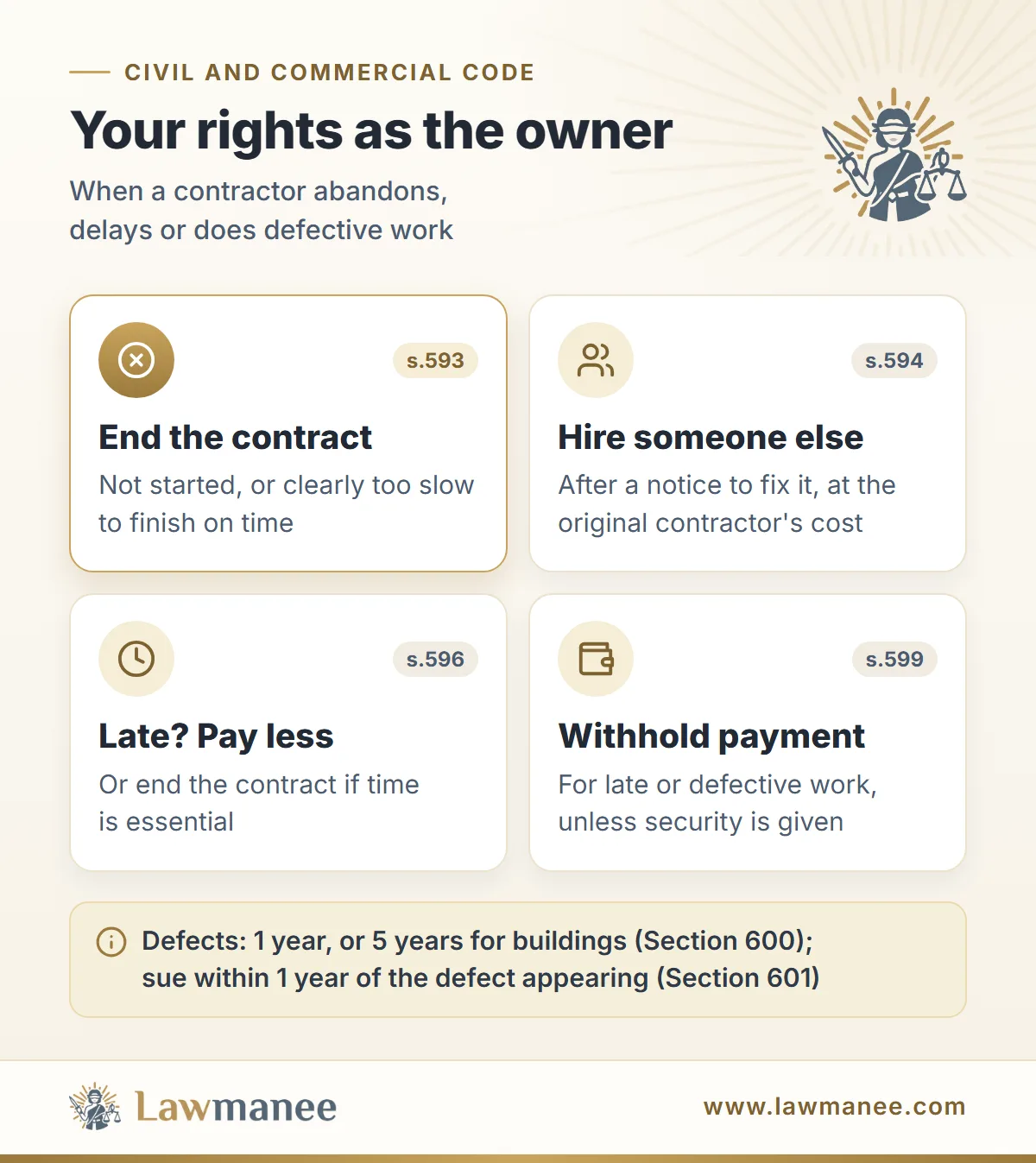
| Problem | Your right | Section |
|---|---|---|
| Work not started, or so slow it clearly cannot finish on time | End the contract at once, without waiting for the delivery date | 593 |
| During the work it is clear the result will be defective or breach the contract | Give notice to fix it within a reasonable time; if not fixed, have someone else do it at the original contractor's risk and cost | 594 |
| Late delivery | Reduce the price, or end the contract if time is essential | 596 |
| Late or defective delivery | Withhold payment, unless the contractor gives adequate security | 599 |
| Work not finished and you simply want to stop | You may end the contract, but must compensate the contractor's loss from ending it | 605 |
Be careful: Section 605 is for an owner who wants to stop although the contractor did nothing wrong. When the contractor abandons the job or breaches the contract, rely on Section 593 or 594 and the contract terms, and state the reasons clearly in your termination letter.
If a defect comes from materials you supplied or from your own instructions, the contractor is not liable, unless they knew the materials were unsuitable or the instructions wrong and did not warn you (Section 591).
What to do, in order, when a contractor walks away
- Stop paying further instalments until the matter is settled. Do not pay in advance for stages that have not been reached.
- Photograph and film the site in full, with dates, before anyone touches it. If you can, have an engineer or inspector assess how much of the work is done and where the defects are.
- Send a notice letter by registered mail with acknowledgment of receipt to the address in the contract. Describe the problem, set a reasonable deadline to return or fix it, and say you will end the contract and hire someone else if they do not.
- End the contract in writing once the deadline passes without the contractor returning.
- Hire a new contractor, and keep the quotations, contract and receipts to claim the difference from the original contractor.
Example: a house contract for 1,000,000 baht is paid in 5 instalments of 200,000 baht. After 3 instalments (600,000 baht) the contractor stops. The owner sends a notice with a deadline, nobody returns, so the owner ends the contract and hires a new contractor to finish for 550,000 baht. The unpaid balance under the old contract was 400,000 baht, so the 150,000 baht difference is damage the owner can claim from the original contractor, on top of the cost of fixing defective work, which has to be proved separately.
Daily penalties in the contract
Many building contracts set a daily penalty for late delivery. This penalty clause is enforceable, but if it is disproportionately high, the court may reduce it to a reasonable amount (Section 383).
Evidence to keep
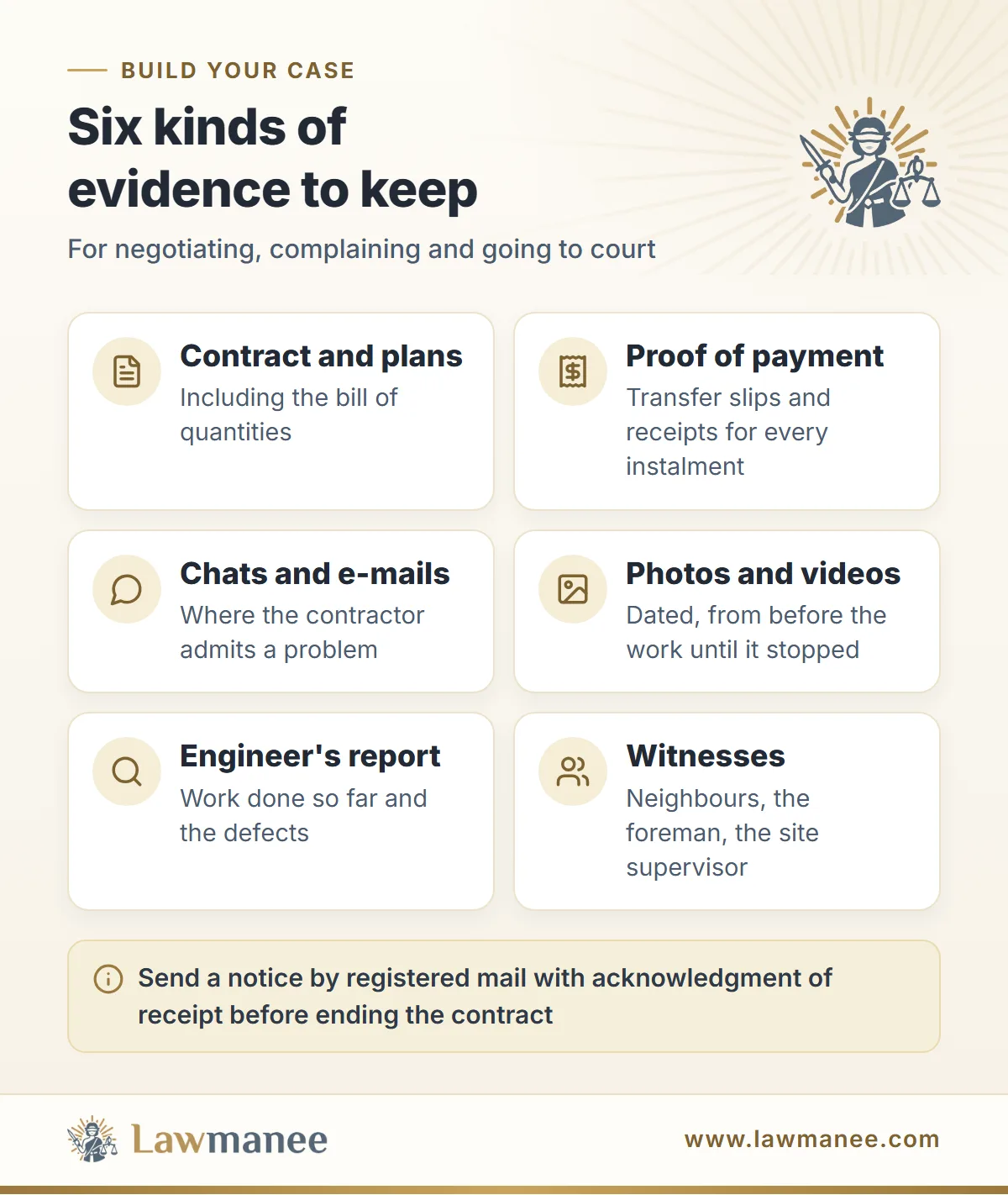
- The contract, house plans and the agreed bill of quantities (BOQ)
- Proof of every payment, such as transfer slips and receipts
- LINE chats, messages and e-mails about the work, especially where the contractor admits a problem or promises to fix it
- Dated photos and videos, from before the work began until the day it stopped
- An engineer's or home inspector's report
- Witnesses, such as neighbours, the foreman or the site supervisor
Finished, but defective
- Inspect before you accept: if you accept defective work without objection, the contractor is not liable, unless the defect could not be found at handover or the contractor concealed it (Section 598). Inspect the work and list the defects in writing on handover day.
- Liability period: unless the contract says otherwise, the contractor is liable for defects that appear within 1 year of delivery, or within 5 years for structures built on land other than wooden buildings. These limits do not apply if the contractor concealed the defect (Section 600).
- Deadline to sue: within 1 year of the day the defect appeared (Section 601). Do not wait too long after you find a crack.
When it becomes fraud
Abandoning a job is usually a civil breach of contract, not automatically a crime. It is fraud under Section 341 of the Criminal Code only if deception with false statements to obtain your money can be proved, for example a contractor who never intended to do the work. Fraud is a compoundable offence: the complaint must be filed within 3 months of learning of the offence and who committed it (Section 96).
Where to sue and where to complain
If the contractor is in the building business and you hired them for your own home, the dispute is a consumer case under the Consumer Case Procedure Act B.E. 2551 (2008). A consumer may file the claim orally, with a court officer recording it (Section 20), and is exempt from court fees (Section 18). Before going to court, you can also complain to the Office of the Consumer Protection Board (OCPB), hotline 1166, which can help mediate.
Foreign owners have the same rights under these rules.
Get a lawyer from the first letter
A notice letter and a termination letter written correctly from the start make damages much easier to recover. On Lawmanee you can describe your situation for free, without personal details, and interested lawyers reply in the platform chat, or search lawyers for civil and property matters by province and language.