
A divorce ends a marriage but not parenthood. What worries people most is usually not the property but the children: who they will live with, who pays for them, and whether the other parent will still see them. This guide explains the rules of Book V (Family) of the Thai Civil and Commercial Code in plain terms.
What parental power means
A child who has not come of age is under the parental power of the parents (Section 1566). Whoever exercises it can decide where the child lives, discipline the child reasonably, demand the child back from anyone holding them unlawfully, and manage the child's property. While the parents are married they exercise it jointly; after a divorce it has to be settled who does.
Parental power and the duty of support are separate. A parent without parental power must still support and educate the child until the child comes of age (Section 1564), and keeps the right to contact the child.
Divorce at the district office: agree in writing
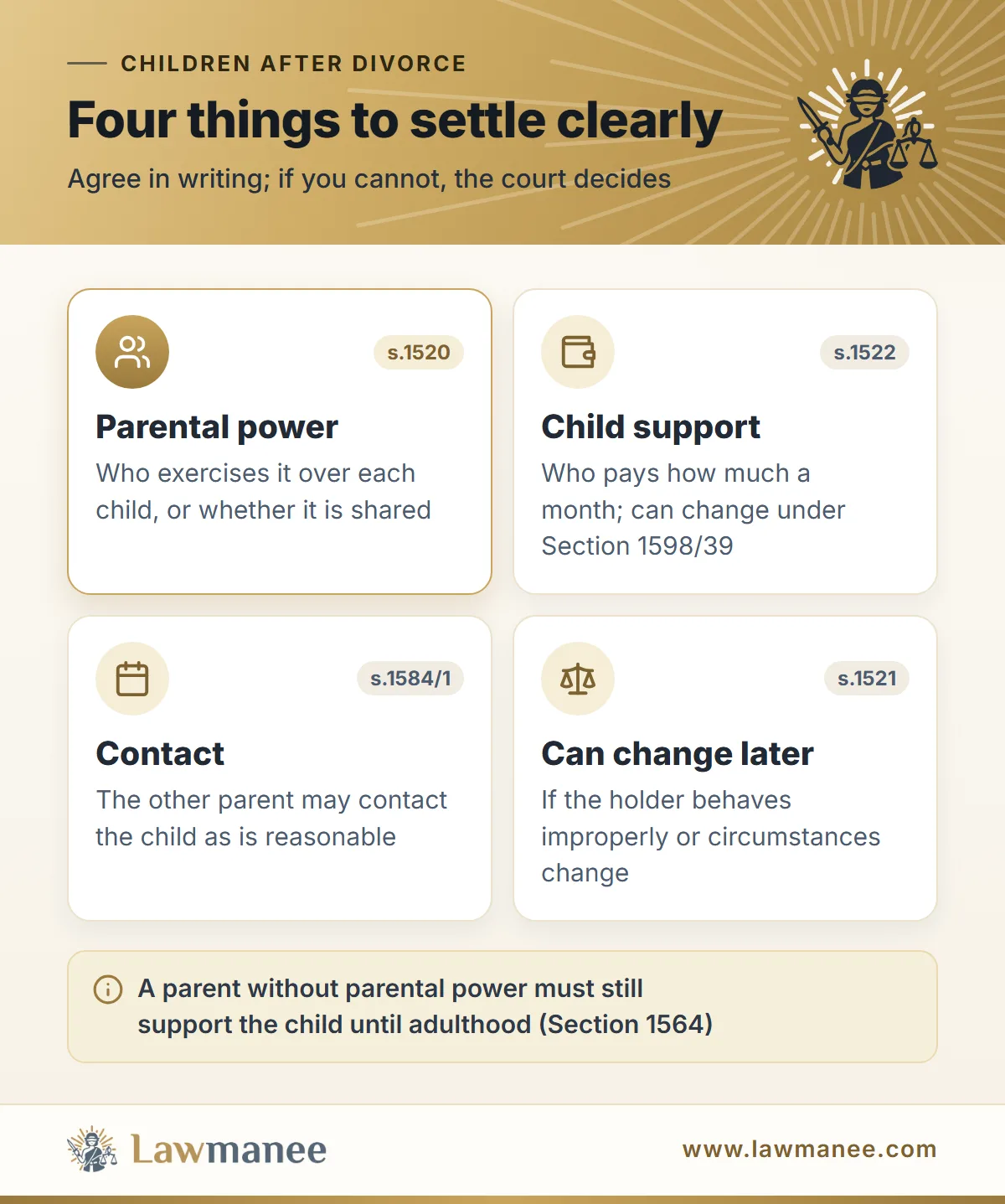
In a divorce by consent, the parents must agree in writing which of them exercises parental power over each child; if they do not or cannot agree, the court decides (Section 1520). The divorce agreement should also say who pays how much child support; if it does not, the court sets it (Section 1522).
A good agreement spells out at least:
- who exercises parental power over each child, or whether it is shared
- where each child lives and goes to school
- the monthly support, the due date and how it is paid
- who pays what share of big costs such as school fees and medical bills
- when the other parent has the children, including school holidays and long weekends
In a contested divorce, the court rules on parental power and child support in the same judgment that grants the divorce.
How the court decides
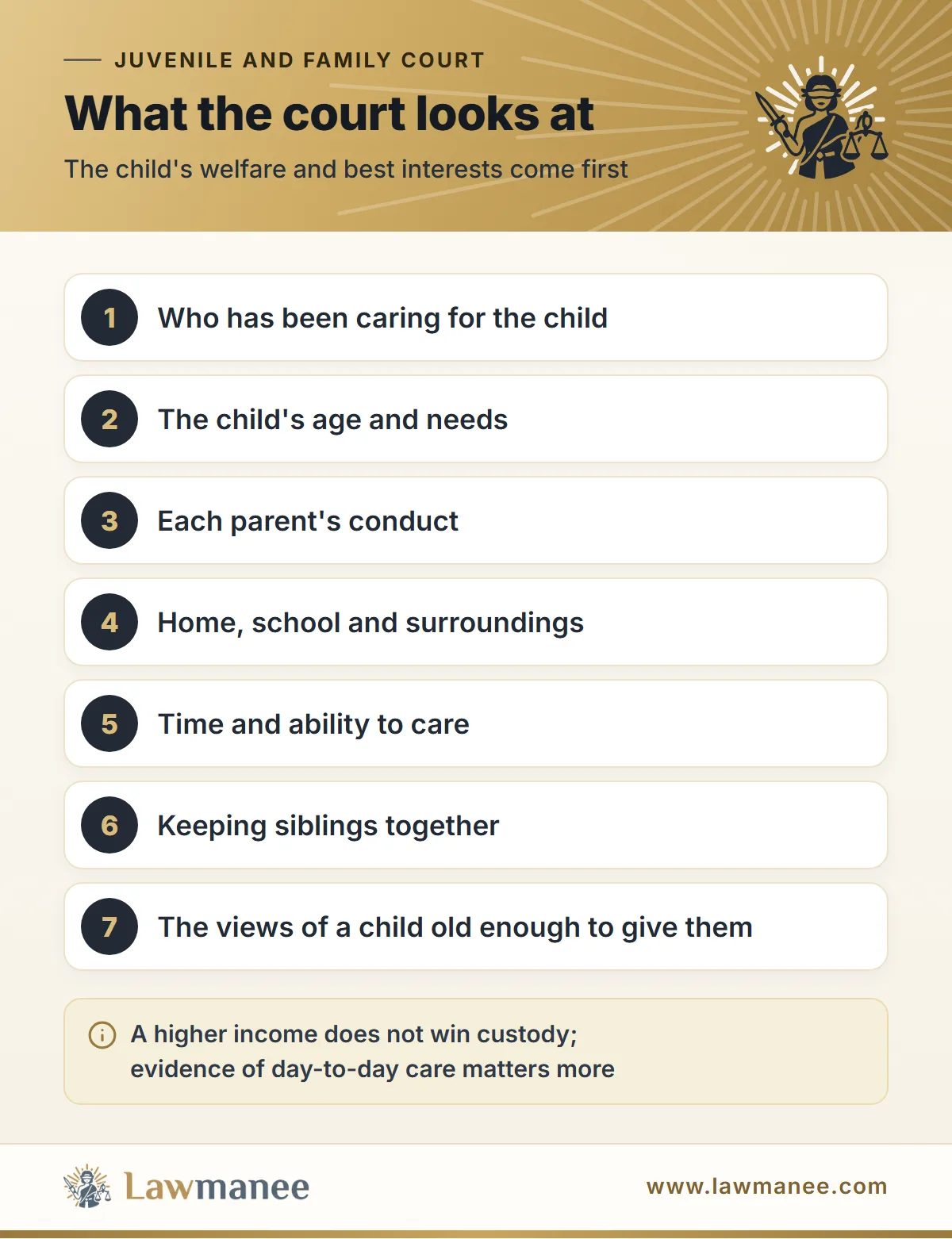
The law does not say that children go to the mother or to the father. The Juvenile and Family Court puts the child's welfare and best interests first. In practice it looks at who has been caring for the child, the child's age and needs, each parent's conduct, the home and school, each parent's ability to care, keeping siblings together, and the views of a child old enough to give them.
A higher income does not win custody, because the other parent pays support anyway. What helps most is evidence that you really care for the child day to day: school runs, doctor's visits, contact with teachers.
Child support: how much, and can it change?
There is no fixed formula. The court sets support according to the payer's ability, the recipient's situation and the circumstances of the case (Section 1598/38), normally as periodic money payments (Section 1598/40).
- It cannot be given away: the right to support cannot be waived or transferred, and creditors cannot seize it (Section 1598/41).
- It can be raised, reduced or stopped when the circumstances, income or situation of either side change (Section 1598/39).
- Unpaid support under a judgment can be enforced against the payer's assets or income. An agreement made at a district office is a contract: if the other parent does not pay, you first have to sue on it.
Example: parents divorce at the district office; the mother exercises parental power over their 6-year-old, and the father agrees to pay 6,000 baht a month. Three years later the child moves to a more expensive school and the father's income has risen sharply. The mother can ask the court to increase the support under Section 1598/39, with evidence of the child's costs and the father's income; the court decides whether and by how much (figures for illustration only).
The other parent's right to contact
A parent has the right to contact their child as is reasonable in the circumstances, whoever exercises parental power (Section 1584/1). The parent with the children should not use them as leverage over money, and the paying parent should not stop paying because they are not seeing the child; the two are separate. If you cannot agree, ask the court to set clear contact arrangements.
Changing or removing parental power
- A change of holder: if the parent exercising parental power behaves improperly or circumstances change, the court can transfer it, with the child's interests first (Section 1521).
- Removal: if parental power is abused or the parent's conduct is grossly wrong, the court can remove it in part or in full at the request of a relative or the public prosecutor (Section 1582).
Children born outside marriage
A child born to a woman who is not in a registered marriage is the legitimate child of the mother (Section 1546), so the mother alone has parental power. The father gains legal rights and duties once he later registers the marriage with the mother, registers the child as his, or a court declares him the father (Section 1547). If he has not recognised the child, the mother can ask the court to declare paternity and claim support.
When one parent is a foreigner
Thai courts apply the same rules to children living in Thailand, and nationality gives neither parent an advantage, but think carefully about where the child will live in the long run. Thailand is a party to the Hague Convention on International Child Abduction, with the Office of the Attorney General as its Central Authority. Taking a child abroad without the consent of the other parent who holds parental power can lead to a request for the child's return, so put travel arrangements clearly in writing.
Talk to a family lawyer
There is no single answer that fits every family, and a carefully written agreement prevents a lot of conflict later. On Lawmanee you can describe your situation for free, without personal details, and interested family lawyers reply in the platform chat, or search lawyers by case type, province and language.