
When a family member dies, the questions that follow are always the same: who does the property now belong to, and what has to be done before the house, the land or the money in the bank can be transferred? This guide explains the main rules of Book VI (Succession) of the Thai Civil and Commercial Code in plain terms.
What the estate is, and when it passes
The estate is all of the deceased's property, together with their rights, duties and liabilities, except those that are purely personal, and it passes to the heirs at the moment of death (Sections 1599 and 1600). The deceased's debts are therefore part of the estate too, but an heir is never liable beyond the property they inherit (Section 1601).
There are two kinds of heirs: beneficiaries under a will and statutory heirs. Whatever the will covers goes as the will says; anything it does not cover passes to the statutory heirs.
The six classes of statutory heirs
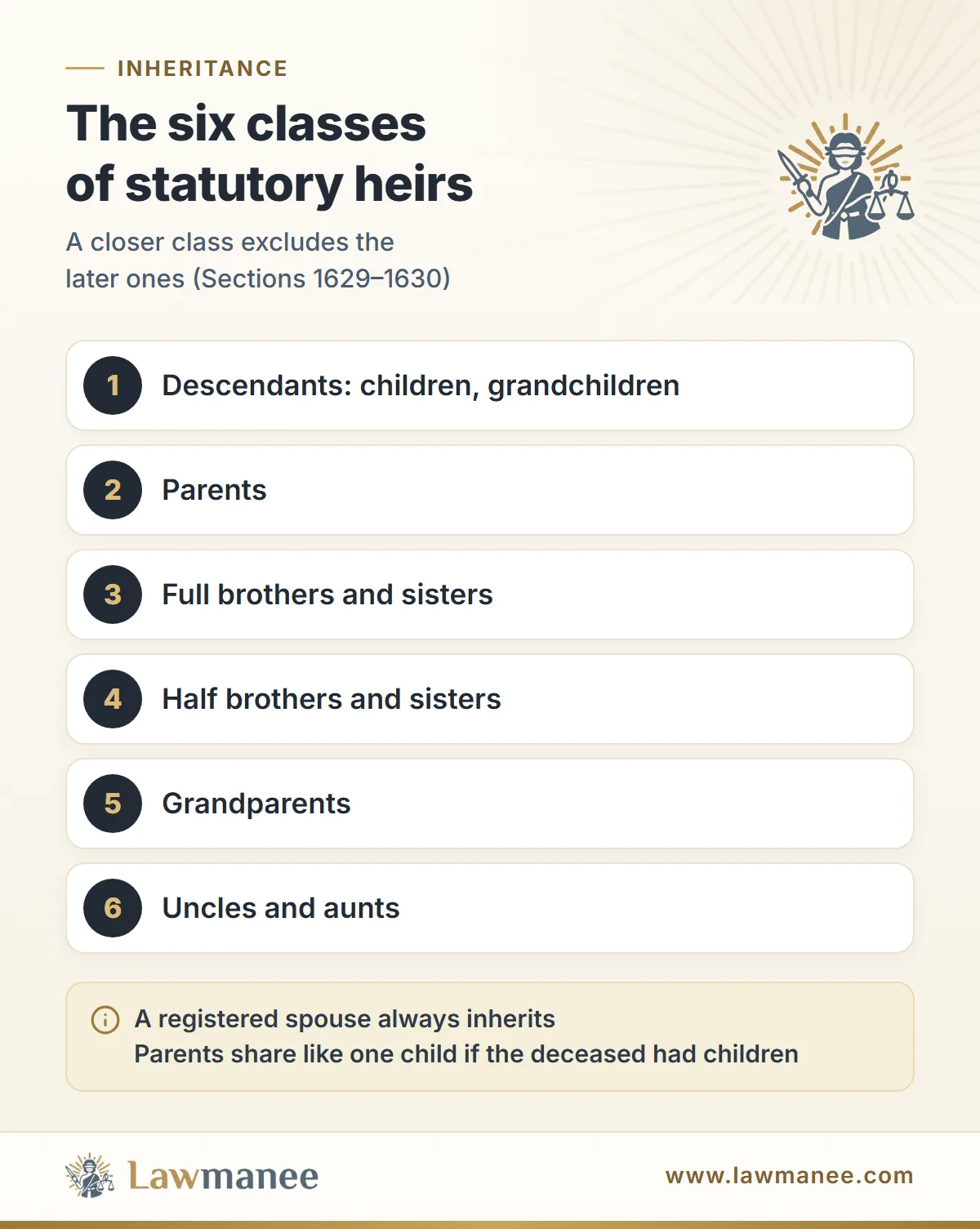
Section 1629 sets out six classes of statutory heirs:
- Descendants, such as children and grandchildren
- Parents
- Full brothers and sisters
- Half brothers and sisters
- Grandparents
- Uncles and aunts
The key rule is that a closer class excludes the later ones: if anyone in a closer class survives, the later classes inherit nothing (Section 1630). The one exception: if the deceased left children and a parent is still alive, the parent receives the same share as one child.
The children who inherit from a father are children born to parents who registered their marriage, children born outside marriage whom the father has legally recognised, and adopted children (Section 1627). From a mother, every child inherits.
What the spouse receives
A spouse with a registered marriage is always a statutory heir. Before the estate is divided, though, the marital property has to be separated: the surviving spouse keeps half of it as its owner, and only the other half, together with the deceased's personal property, forms the estate to be divided.
The spouse's share of the estate depends on which other heirs survive (Section 1635):
| Other heirs | The spouse receives |
|---|---|
| Children or other descendants | the same share as one child |
| No descendants, but parents or full siblings | half of the estate |
| Only half-siblings, grandparents, or uncles and aunts | two-thirds of the estate |
| No other statutory heirs | the whole estate |
For example, a husband dies leaving 4 million baht of marital property and no personal property, and is survived by his wife and two children; his parents have already died. His wife first takes her half of the marital property, 2 million baht. The other 2 million baht is the estate, shared equally between the wife and the two children, about 666,667 baht each.
A partner who lived with the deceased without registering the marriage is not a statutory heir. If you want your property to go to such a partner, make a will.
Forms of will
- Ordinary will: in writing, dated, and signed by the testator in the presence of at least two witnesses at the same time, who sign to certify it (Section 1656).
- Holographic will: written entirely in the testator's own hand, dated and signed; no witnesses needed (Section 1657).
- Public will: made before an official at a district office (Section 1658).
- Secret will and oral will: for special circumstances (Sections 1660 and 1663).
The person who writes a will for the testator, the witnesses, and their spouses cannot benefit under that will (Section 1653), and a will that does not follow the required form may be invalid, so have a lawyer check it before you sign. If the deceased or an heir is a foreign national, other rules may apply, for example to land in Thailand and to property abroad.
When you need an estate administrator
An estate administrator has the power to collect, manage and distribute the estate. The court appoints one on the petition of an heir, an interested person or the public prosecutor (Section 1713). In practice, banks and other institutions usually ask for a court order appointing an administrator before releasing the deceased's money or transferring their assets, especially when the amounts are large, there are several heirs, or an heir is a minor.
For land, heirs can sometimes apply to the Land Office directly to register the inheritance; the officer then publishes a 30-day notice to interested persons before registering.
Appointing an estate administrator in 5 steps
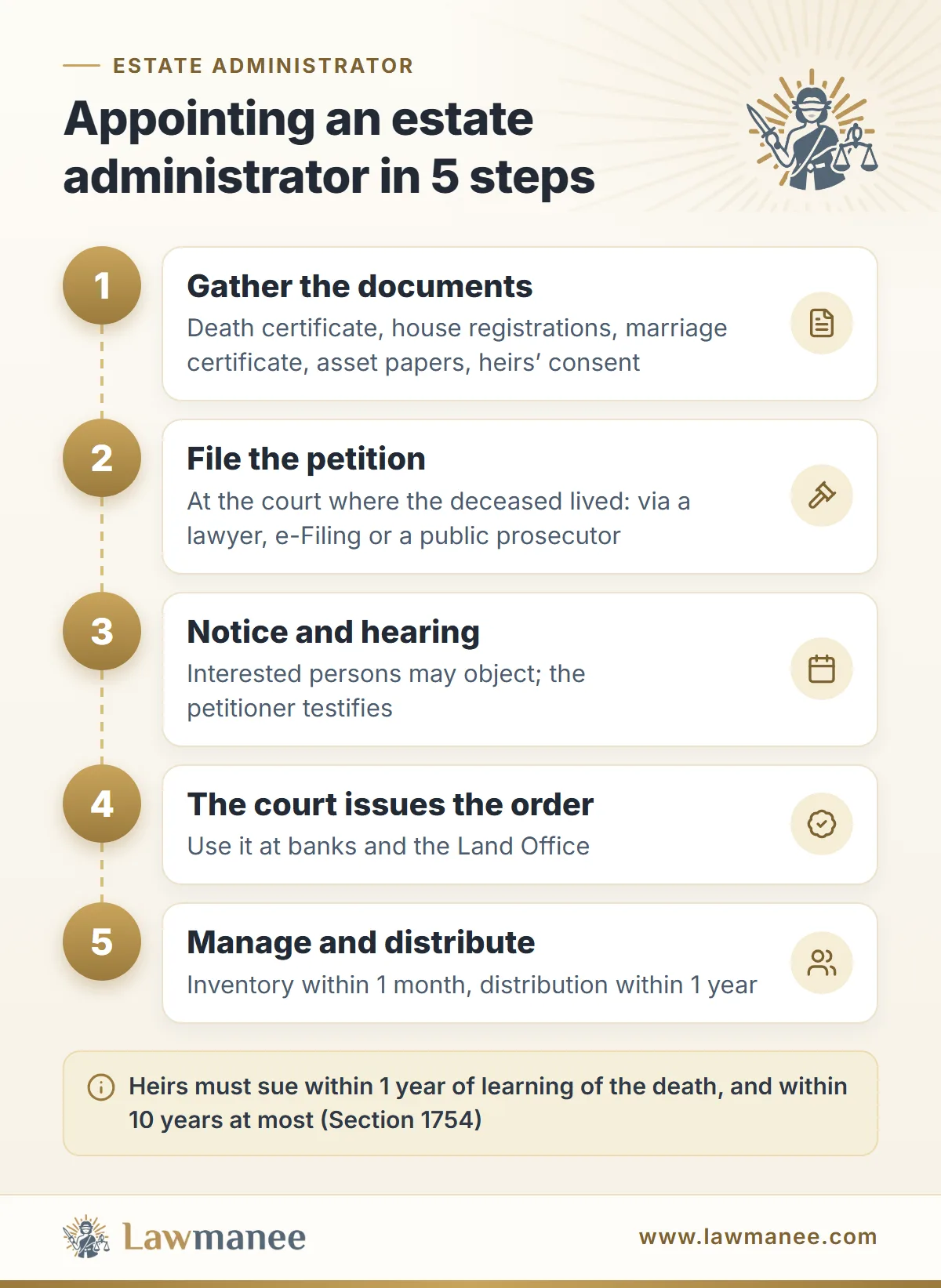
- Gather the documents: the death certificate, house registrations and ID cards of the deceased and the petitioner, the marriage certificate, the heirs' birth certificates, a family tree, proof of assets such as title deeds and bank books, the will (if any), and the other heirs' written consent.
- File the petition with the court for the area where the deceased was domiciled at death. You can file through a lawyer, through the Court of Justice e-Filing system, or ask a public prosecutor's legal aid office to file it without a service fee (you still pay the court fees).
- Notice and hearing: the court publishes a notice so that interested persons can object, and the petitioner testifies at the hearing.
- The court issues the order: take it to banks, the Land Office and other institutions.
- Manage and distribute the estate: the administrator must start the inventory within 15 days and finish it within 1 month (Sections 1728 and 1729), then complete the distribution within 1 year (Section 1732), unless another deadline has been set.
Deadlines and tax to know
- Time limit: heirs must sue for their inheritance within 1 year of learning, or when they should have learned, of the death, and never later than 10 years after it (Section 1754). The deceased's creditors must also sue within 1 year of learning of the death. Heirs who already hold the estate jointly can still demand a division (Section 1748).
- Inheritance tax: an heir who receives a net inheritance of more than 100 million baht pays tax on the excess only, at 5% for ascendants and descendants and 10% for anyone else; a spouse is exempt (Inheritance Tax Act B.E. 2558).
Talk to a lawyer about an estate
Every family's situation is different: heirs may disagree, there may be assets abroad, or an heir may be a foreign national with special rules for inheriting land. On Lawmanee you can describe your situation for free so that inheritance lawyers can contact you, or search lawyers by case type, province and language.