

Buying a house in a Thai housing estate (หมู่บ้านจัดสรร, often called a moo baan) means sharing its roads, parks and playgrounds with every other house. Residents keep asking the same questions: who has to maintain all this, what the common fees are based on, what happens when someone pays late, and how residents can take the estate over themselves.
The answers are in the Land Allocation Act B.E. 2543 (2000), last amended by the Land Allocation Act (No. 3) B.E. 2568 (2025), in force since 1 March 2026. This guide covers what buyers and residents need to know.
What counts as a housing estate
The Act calls it land allocation when land divided into 10 or more plots is sold, whether the plots come from one title or from several adjoining ones. It also covers dividing land into fewer than 10 plots and then dividing more within 3 years, so that the total reaches 10 or more (Section 4).
- Nobody may allocate land without a permit from the land allocation committee (Section 21): outside Bangkok the provincial committee, chaired by the provincial governor; in Bangkok the Bangkok Land Allocation Committee.
- The developer must display the permit, the plan, the project and the approved allocation method in an open and visible place at the project office (Section 31), so you can check them before you buy.
- Public utilities are the facilities the developer provides for the buyers' shared use, such as roads, parks and playgrounds.
Condominiums fall under a different law, the Condominium Act; see our guide to condo juristic persons.
Roads and parks carry a servitude for every plot
The utilities the developer provides are subject to a servitude (ภาระจำยอม) for the benefit of the allocated plots (Section 43). Even while the land under a road or a park is still in the developer's name, every plot in the estate has the right to use it, and the developer may not do anything that reduces that benefit or makes it less convenient.
Section 43 also requires the developer to:
- maintain the utilities so that they work normally, to no lower a standard than the original; and
- arrange a maintenance guarantee contract for the utilities it built and is still responsible for.
If the developer reduces the benefit of the servitude or departs from the approved plan, project or allocation method, the committee can order it to stop, to keep the utilities working normally, or to follow what was approved (Section 52). A developer that disobeys such an order faces a fine plus a daily fine for as long as the breach continues.
Residents with a problem can report it to the committee. The provincial land officer is the secretary of a provincial committee; in Bangkok, a Department of Lands representative is the secretary.
How long the developer must maintain the estate
When applying for the permit, the developer submits a plan, project and period for maintaining the utilities (Section 23 (5)). After that period, the developer is released from the maintenance duty only when one of the following has been done, in this order (Section 44):
- The buyers set up a housing estate juristic person (or a juristic person under another law) to take over and maintain the utilities, within a period the developer sets, which must be at least 180 days from the notice.
- The developer dedicates the utilities to public use, or obtains the committee's approval for another way of maintaining them.
Either way, the developer must then hand over the amount under the maintenance guarantee contract to the housing estate juristic person or to the local government, as the case may be.
The 2025 amendment adds a way out for residents: if the developer does not arrange for the buyers to set up the juristic person, or does not maintain the utilities, buyers of at least half of the plots already sold under the project plan can apply to the provincial land officer (or the branch office) to set up a housing estate juristic person.
Setting up a housing estate juristic person
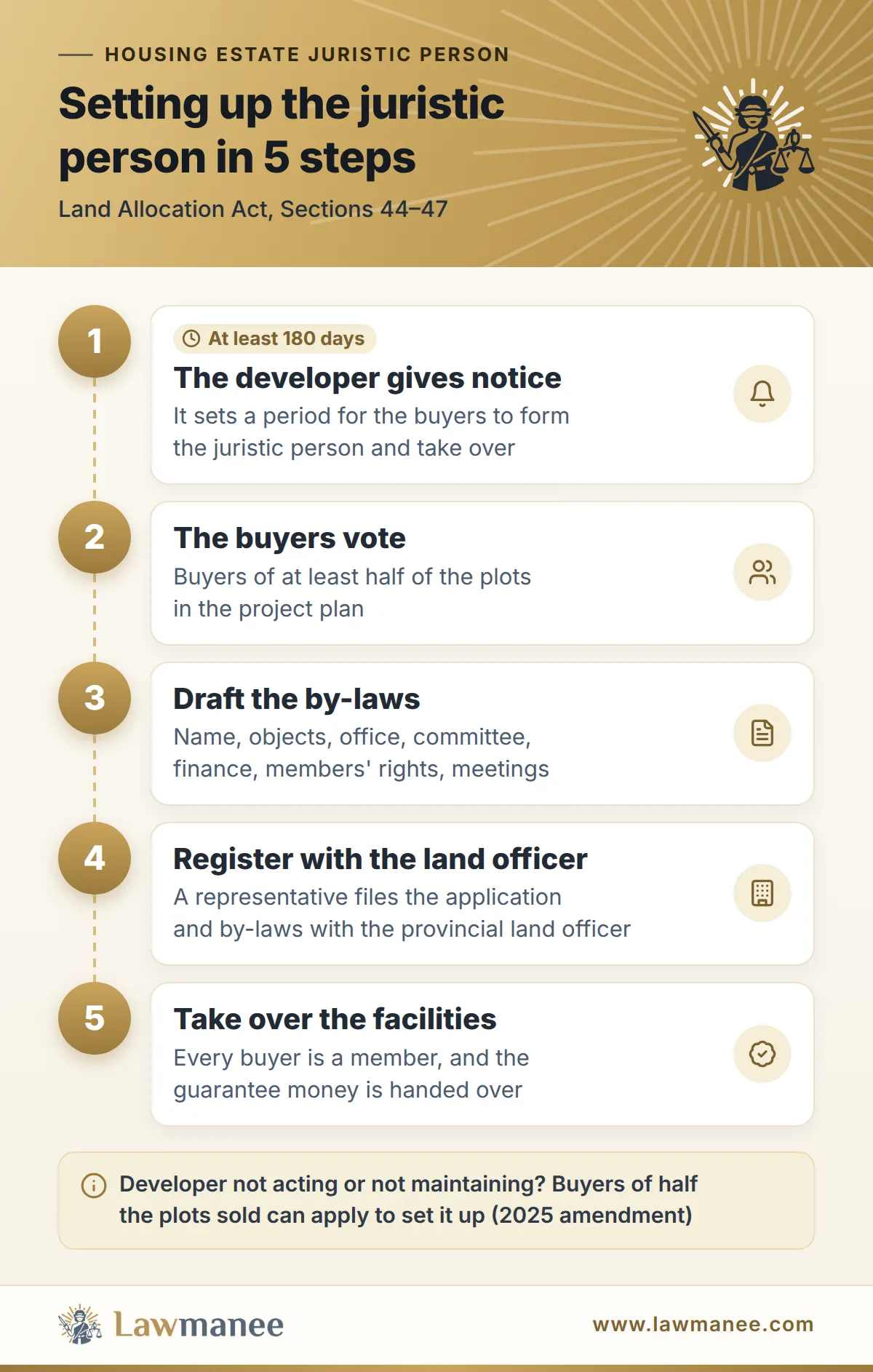
In the normal case, Sections 45 to 47 work like this:
- Resolution: buyers of at least half of all the plots in the project plan resolve to set up the juristic person and appoint a representative to apply.
- By-laws: at a minimum the name, objects, office, rules on the committee, operations, accounts and finance, members' rights and duties, and general meetings, as set out in the ministerial regulation.
- Registration: the representative files the application and the by-laws with the provincial land officer or the branch land officer.
- Juristic person: once registered, a housing estate committee runs it under the supervision of the members' general meeting and represents it towards third parties (Section 46).
- Members: every buyer of a plot is a member; for plots not yet sold or transferred back to the developer, the developer is the member (Section 47).
What the juristic person can do
Section 48 gives it these powers and duties in the buyers' interest; some need a resolution of the members' general meeting first.
| Power or duty | General meeting resolution needed? |
|---|---|
| Rules on the use of the utilities | Yes |
| Rules on living in the estate and on traffic | Yes |
| Collecting the maintenance and management fee from members | The rate needs approval (Section 49) |
| Filing complaints or suing on behalf of members where the rights or interests of 10 or more members are affected | Not required by Section 48 |
| Providing public services for members' welfare, or allocating money or property for public benefit | Yes |
| Other acts under ministerial regulations, rules or the by-laws | Not required by Section 48 |
How common fees work
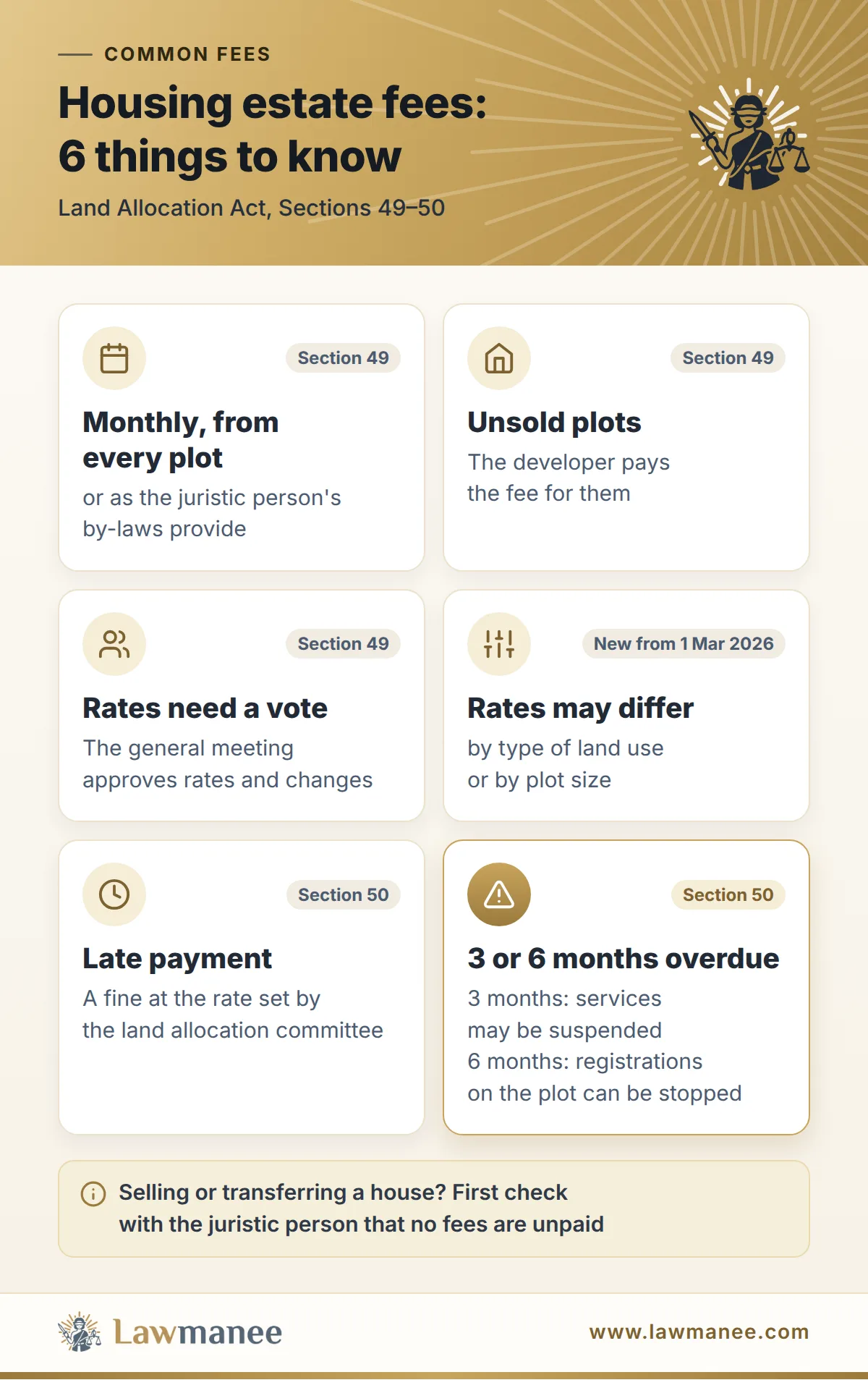
What people call common fees is, in the Act, the fee for maintaining and managing the utilities. Section 49 sets these rules:
- The fee is collected monthly from every plot in the estate, or as the juristic person's by-laws provide.
- Buyers pay for their own plots; the developer pays for plots not yet sold.
- Setting or changing the rate needs a resolution of the members' general meeting, or the committee's approval where the developer was approved to maintain the estate another way.
- Since 1 March 2026, rates may differ by type of land use or by plot size, under rules of the Central Land Allocation Committee.
Paying late and arrears
Section 50 sets out the consequences step by step:
- Paying after the due date: a late-payment fine at the rate set by the land allocation committee.
- 3 months or more in arrears: services or the use of the utilities may be suspended.
- 6 months or more in arrears: the land officer may suspend the registration of rights and transactions on that plot until the full amount is paid.
The last rule matters when you sell or transfer a house: before the transfer date, check with the juristic person that the plot has no unpaid fees.
If you are a foreign resident
Foreigners generally cannot own land in Thailand (see our guide to foreigners and land). If you rent a house in an estate, or the plot is in your Thai spouse's name, note that under the Act the member of the juristic person and the person who pays the fee is the buyer of the plot (Sections 47 and 49). Whether a tenant has to cover the common fee depends on the lease.
Checklist before buying in a housing estate
- Look at the permit, plan and project the developer must display at its office.
- Ask whether a housing estate juristic person has been set up. If not, the developer still has to maintain the utilities.
- Ask for the by-laws, the fee rate and the rules on using the utilities.
- Buying a resale house? Check the plot's common fee status with the juristic person before the transfer date.
Talk to a lawyer about a housing estate
Housing estate problems depend on the facts of each project: the developer has not handed over the utilities, residents want to set up the juristic person themselves, or you are unsure whether a fee resolution was valid. On Lawmanee you can describe your situation for free and interested lawyers reply in the platform chat, or search lawyers by case type, province and language.