


Your neighbour has raised their land until it sits higher than your fence, and every time it rains, water pours into your home, sometimes carrying mud and soil that push against the wall. The questions that follow: how far may a neighbour fill their land, do you have to wait for damage before acting, and where do you complain? This guide explains the Land Excavation and Filling Act B.E. 2543 (2000) and the relevant parts of the Civil and Commercial Code, with the steps to take.
Filling your own land is allowed, but it comes with duties
An owner may fill their own land, but the law makes sure the filling does not cause trouble next door. The main law is the Land Excavation and Filling Act B.E. 2543 (2000), which defines filling as any act on soil or ground that raises its level (Section 4).
The Act does not apply everywhere. It applies in municipalities, Bangkok, Pattaya, other local government areas the Minister designates in the Royal Gazette, areas where a royal decree applies the building control law, and comprehensive town plan areas (Section 3). It is enforced by the local official: the mayor of the municipality, the Governor of Bangkok, the Mayor of Pattaya or the head of the subdistrict administrative organisation (SAO). If you are not sure whether your area is covered, ask the local office where the land lies. The Civil and Commercial Code rights explained below apply everywhere.
What the person filling must do
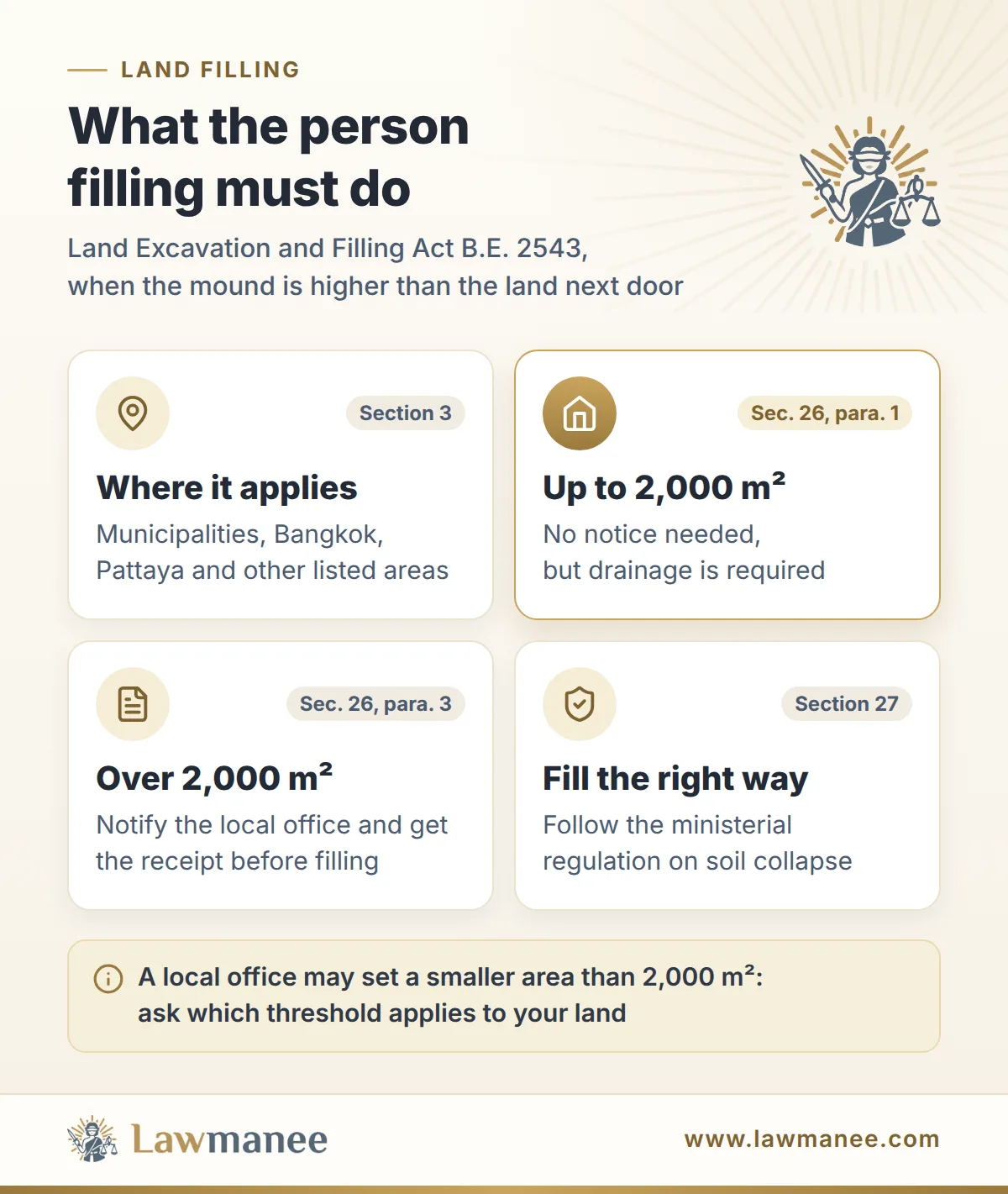
The duties depend on the size of the mound, meaning the soil raised by filling, when it is higher than the adjoining land of another owner:
| Situation | Duty | If breached |
|---|---|---|
| Mound area up to 2,000 m², or up to the area the local office announces | Provide drainage adequate not to cause trouble to adjoining owners or others (Section 26, paragraph 1) | Pinai fine of up to 10,000 baht (Section 37) |
| Mound area over 2,000 m², or over the announced area | Notify the local official on the official form; a correct notice gets a receipt within 7 days (Section 26, paragraphs 3 and 4) | Filling without the receipt: up to 1 year in prison, a fine of up to 50,000 baht, or both (Section 35) |
| Both cases | Fill in accordance with the ministerial regulation issued under the Act (Section 27) | Pinai fine of up to 30,000 baht plus up to 1,000 baht a day until it is put right (Section 36) |
Worth knowing:
- A local office may announce a smaller area than 2,000 m², never a larger one (Section 26, paragraph 2), so ask which threshold applies where you live.
- A small fill that needs no notice still carries the drainage duty.
- Section 6 lets the Minister regulate matters such as slope, height and distance by soil type, and methods to prevent the collapse of soil or structures.
- A pinai fine, under the Pinai Fines Act B.E. 2565 (2022), is not a criminal penalty: there is no detention in place of the fine and no criminal record. Offences that carry imprisonment remain criminal.
"Water runs downhill" is no excuse
Section 1339 of the Civil and Commercial Code requires an owner to accept water that flows naturally from higher land, so you should not block a natural watercourse that has always crossed your land. But that section is about water flowing naturally. A neighbour who raises their land above yours already has a duty under the filling law to provide drainage so that you are not troubled, and saying that water simply runs downhill does not remove that duty.
No need to wait for damage: ask the local office to inspect
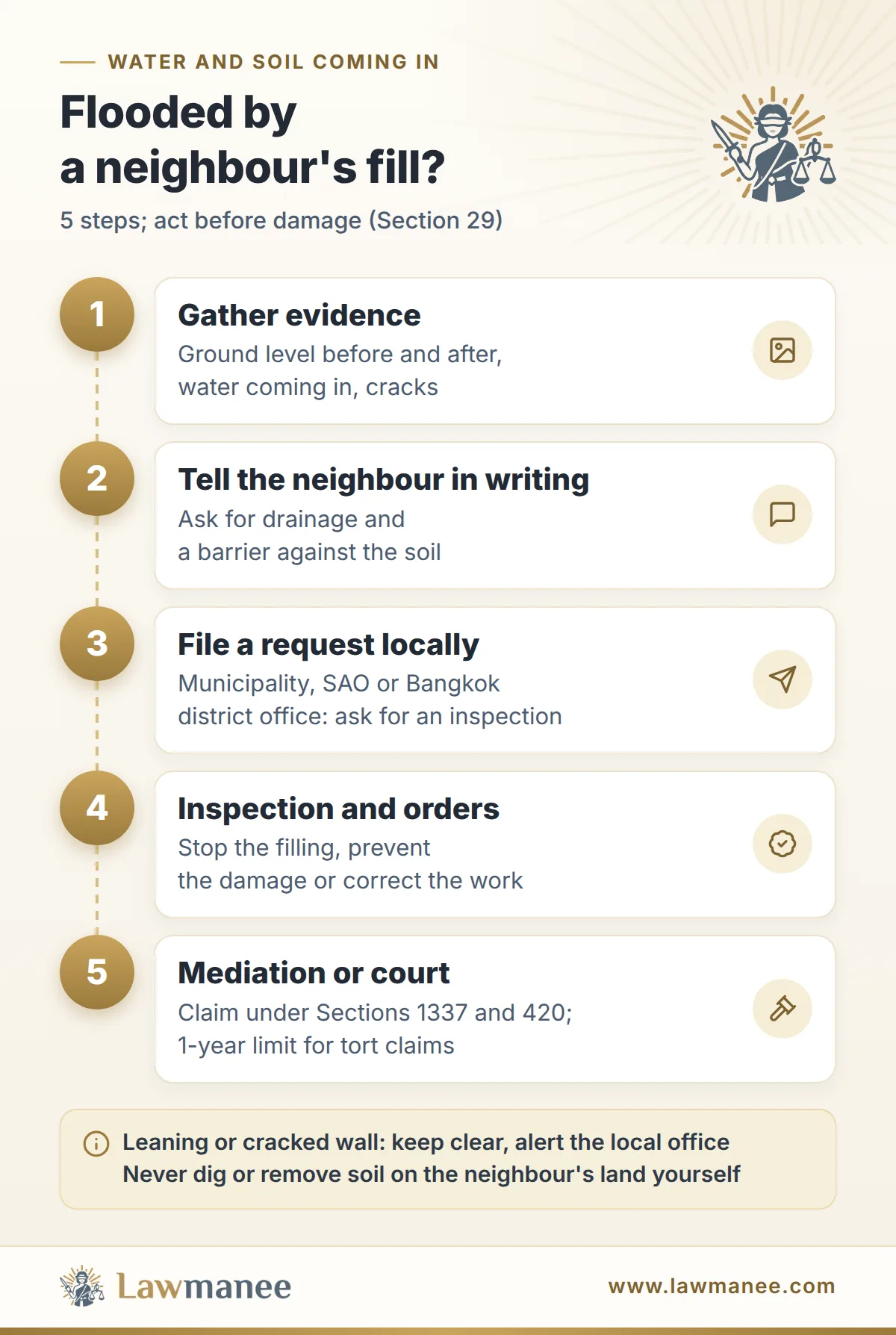
Under Section 29, anyone who is damaged, or has reasonable grounds to believe they may be damaged, by filling that does not follow the ministerial regulation (Section 27) may make a request to the local official. The local official must then send officers to inspect the site and report. If damage has occurred or may occur, the local official may order the person filling or the landowner in writing to:
- stop filling;
- take measures to prevent the damage that may occur; or
- correct the filling.
So you do not have to wait until your house floods or the wall falls before you ask. It does not mean the office will issue an order every time a neighbour fills high, though: the order depends on what the inspection finds. Ignoring a stop order is punishable by up to 1 year in prison, a fine of up to 50,000 baht, or both (Section 40); ignoring an order to prevent damage or correct the work carries a pinai fine of up to 30,000 baht plus up to 500 baht a day (Section 41).
Where to file: the engineering or public works division of the municipality or SAO where the land lies; in Bangkok, the public works section of the district office, or report through the 1555 hotline or Traffy Fondue. If nothing happens, the Damrongtham Centre hotline 1567 is another channel.
How to write the request: put it in writing, giving the location of both plots (and the title deed numbers if you know them), when the filling started, roughly how much higher it is than your land, and what happens when it rains, with photos. Ask for both the drainage and the protection against soil collapse to be inspected, and keep the reference number of your request.
If a wall is leaning or cracked: keep everyone away from it first, then tell the local office at once. Do not go onto the neighbour's land to dig or remove soil yourself; you could end up accused of trespass or damage to property.
Renting? Section 29 covers anyone who is or may be damaged, so a tenant can ask for an inspection too. The right under Section 1337 belongs to the owner of the property, so tell your landlord early. Local offices work in Thai, so bring a Thai speaker if you can.
Keep evidence from day one
- Photos or video of the ground level before and after the filling, with dates
- Water or mud coming in on rainy days, and water marks on walls or the fence
- Cracks, a leaning wall or damaged belongings, with repair quotes or receipts
- Messages or letters to the neighbour, and the reference number from the local office
For other kinds of neighbour trouble, such as noise, smoke or smells, Lawmanee explains the complaint routes in how to deal with noisy neighbours, smoke or smells.
Claiming damages and going to court
If the filling causes trouble beyond what can reasonably be expected in the ordinary course, the owner has the right under Section 1337 to have the trouble brought to an end, and may also claim compensation. Damage to property caused intentionally or negligently can also be claimed as a wrongful act under Section 420.
- Time limit: a claim for damages for a wrongful act must be brought within 1 year from the day you knew of the act and of the person liable, and never later than 10 years from the act (Section 448).
- Mediate first: many cases end with an agreement to build a drain or a soil barrier together. See how mediation before going to court works.
Example
Nida lives in a single-storey house. The plot next door, 1 rai (1,600 m²), belongs to a neighbour, who fills the whole plot about 1 metre above Nida's land without any drainage. After heavy rain, muddy water seeps under the fence into her house and the soil starts to push the fence out of line.
- 1,600 m² is not over 2,000 m², so unless the local office has announced a smaller area, the neighbour did not have to give notice, but must provide adequate drainage.
- Nida can file a written request for an inspection at once, without waiting for the fence to fall. If the inspection finds that the filling does not follow the ministerial regulation and damage may occur, the office can order prevention or correction.
- Her receipts for repairing the fence and cleaning the house come to 40,000 baht; she should claim within 1 year of knowing of the wrongful act and who is liable.
If you are the one filling
Before you start, ask the local office whether your land is covered, which area needs a notice, and whether it lies in a no-fill zone. Plan the drainage and the protection against soil collapse before the work begins, photograph the original ground level, and tell your neighbours in advance. That prevents most disputes from the start.
Talk to a lawyer about land filling and neighbours
Land filling disputes turn on specific facts: the original ground level, the boundary, the water path and the proof of damage. A lawyer can draft letters to the neighbour and the local office and assess whether to sue. On Lawmanee you can describe your situation for free so that interested property lawyers reply in the platform chat, or search lawyers by case type, province and language.